
Recreating the Roland MPG80

The rackmount version of the Roland Jupiter 6 was the MKS-80, released in 1984. A dedicated programmer was then available, the MPG80.
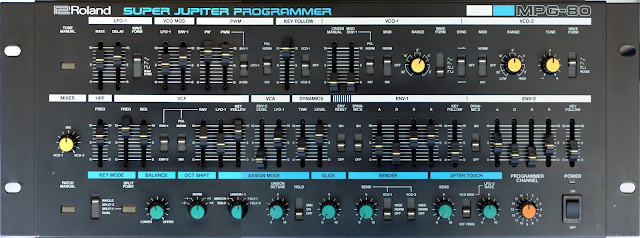

30 years later, the MKS-80 is a sought after intrument and the MPG-80 is even rarer.

My project is to recreate a MPG-80, based on modern components, Because of the position of the MPG-80 in the MIDI chain, I take this opportunity to add some goodies:
- a main power switch to swith on/off both units
- a upper/lower toggle switch which avoids to select it on the MKS-80
- an arpeggiator syncable on MIDI and External trigger
- More memory to store paches and tones
- Menu switches & LCD display to add further goodies


In the original MPG-80, there is no feedback from the MKS-80. Hence, no protocol is possible (ie the MPG-80 cannot read the settings from a patch; it only sends the new values to the MKS-80).

In the new version, there are 2 MIDI IN, which allows a feedback from the MKS-80. The MPG-80 can request the parameters from a patch and change the LED display accordingly.
The second MIDI IN allows the keyboard to drive the internal arpeggiator, such as on the Roland Jupiter 6. Furthermore, I added an analog sync in / sync out to allow syncing the arpeggiator clock to an analog signal, or syncing an external arpeggiator (such as Roland Juno or Korg Polysix) to the MIDI clock.

Current status:
- Redesign of the pannel layout: finished
- Redesign of the electronic: almost finished
- Programming: started
- Redesign of the casing:started

Comments

Kabale said…
great projec! how far are you on the development with this one?
On hold, but not dead. I recently discovered a Chinese company which makes PC prototyping at good price: JLC PCB Prototype
Misc15 said…
Seen this?
https://retroaktivsynthesizers.com/collections/controllers/products/mpg-8x-super-jupiter-programmer-pre-order
Yes, I did already checked that. I don't really like the JP8 look. Pretty expensive as well, but a nice product indeed. My project is slowly making progress, but I have so many other toys to play with... ;-)

Popular posts from this blog

Drive replacement for Fostex DMT8-vl

The IDE hard drive on my Fostex DMT8-vl multitrack recorder shows signs of its imminent death; when getting hot, I could not record anymore. Must be said this drive comes from an old Sun Station, and has been replaced because I/O failures were detected by Solaris. It worked at least 5 years in my recorder: not so bad. However, time is now to replace it. The DMT8-vl is not able to handle drives bigger than 8.4 GB. Well, it is able to (the current drive is 15 GB), but only 8.4 GB will be usable. My tought was to use a 8 GB CompactFlash; having no moving parts means no noise, which is quite temptating for a music recording device. I purchased a CompactFlash-IDE adapter on the internet (8$) and I had to build a male-male IDE cable adapter (4$). Unfortunately, this doesn't work. The drive is correctly discovered by the operating system, which proposes to format it ("format IDE?"). After answering "yes", the formating runs pretty fast (faster than on a real drive), ...

Samba: Clients get "system error 1223" (or 123) after a server reboot

Facts: a Linux+Samba server shares anonymously a folder. After a reboot, Win clients could not attach the share drive anymore. C:\>net use \\mylinux\folder Enter the user name for 'mylinux': System error 1223 has occurred. The operation was canceled by the user. C:\>net view \\mylinux\ System error 123 has occurred. The filename, directory name, or volume label syntax is incorrect. The process are present, and tcpdump doesn't provide much information. What's going on? After hours of headscratching, the light came: the firewall was on and no rules for the Samba protocol! Grrr!

Issue with Soundpool MO4

I have a Atari STe with a Soundpool MO4 MIDI extension. It used to work very well, but unfortunatelly doesn't anymore: Cubase still detects it, and I can output MIDI to it but nothing is coming out from any MIDI Out. It took me a while to tackle it (lack of time, lack of tool, other items to play with), but I gave a glance last week-end. The parallel port on the Atari uses only the following signals: Pin 1 : Strobe (Atari -> MO4) Pin 2 : Data 0 (Atari -> MO4) Pin 3 : Data 1 (Atari -> MO4) Pin 4 : Data 2 (Atari -> MO4) Pin 5 : Data 3 (Atari -> MO4) Pin 6 : Data 4 (Atari -> MO4) Pin 7 : Data 5 (Atari -> MO4) Pin 8 : Data 6 (Atari -> MO4) Pin 9 : Data 7 (Atari -> MO4) Pin 11: Busy (MO4 -> Atari) The MO4 also decodes few other pins, but since the Atari doesn't, my guess is the MO4 was also targeted for PC. Inside the box, the MO4 is architectured around a CPLD (IspLSI1016 from Lattice) which contains the logi...