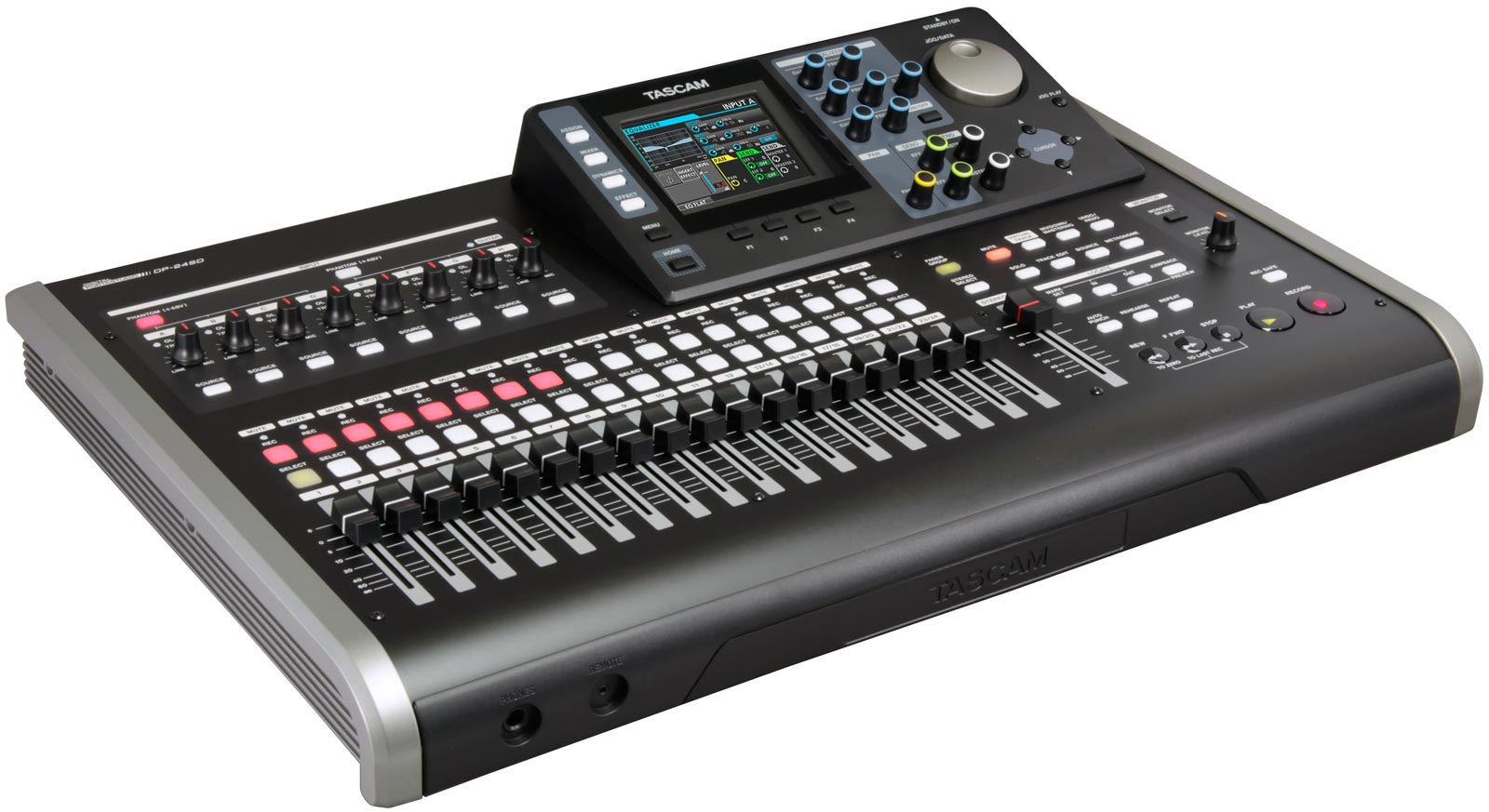
Tascam DP24/DP32 allows to drive the front panel with MIDI. Each individual parameter from track channel, audio input or stereo mix can be change with simple CC (Control Change) commands. This is very helpful to automate mixing or to create special effects such as stereo panning.
How to access the parameters?
Selecting the bank. The DP24/DP32 has respectively 24 and 32 audio track channels, grouped into "banks" of 8 channels; the bank must be selected before accessing the individual channel. This is done by sending a 'Bank Select LSB' on MIDI channel 14, followed by the bank number:
| Bytes | On DP24 | On DP32 |
|---|---|---|
| 0xBD 0x20 0x00 | Bank 0 | Bank 0 |
| 0xBD 0x20 0x01 | Bank 1 | Bank 1 |
| 0xBD 0x20 0x02 | Bank 2 | Bank 2 |
| 0xBD 0x20 0x03 | Bank 3 | Bank 3 |
| 0xBD 0x20 0x04 | Bank 4 |
Selecting the channel. Inside a bank, MIDI channel 1 to 8 is associated with a track channel; MIDI channel 16 is always Stereo Master, no matter which bank is selected.
To control a parameter on an audio channel, the Control Change byte selects the audio channel:
| Bank selected | Control Change... | ... controls (DP24) | ... controls (DP32) |
|---|---|---|---|
| Bank 0 | 0xB0 to 0xB7 | Channel 1 to 8 | Channel 1 to 8 |
| Bank 1 | 0xB0 to 0xB7 | Channel 9 to 16 | Channel 9 to 16 |
| Bank 2 | 0xB0 to 0xB7 | Channel 17 to 24 | Channel 17 to 24 |
| Bank 3 | 0xB0 to 0xB7 | Input A to H | Channel 25 to 32 |
| Bank 4 | 0xB0 to 0xB7 | Input A to H | |
| 0xBF | Stereo Master | Stereo Master |
Selecting the parameter. The parameter to control is selected by sending a 'Bank Select MSB', followed by the desired value:
| Bytes | Parameter | value |
|---|---|---|
| 0xBn 0x07 value | Internal level | 0 (0x00) → 127 (0x7F) |
| 0xBn 0x0A value | Panning | 0 (0x00) = left → 127 (0x7F) = right 64 (0x40) = center |
| 0xBn 0x0B value | Digital Trim | 0 (0x00) = -42 dB → 48 (0x30) = +6 dB |
| 0xBn 0x10 value | EQ Low Freq | 0 (0x00) → 31 (0x1F): ➥ table below |
| 0xBn 0x11 value | EQ Low Gain | 0 (0x00) = -12 dB → 24 (0x18) = +12 dB |
| 0xBn 0x12 value | EQ Mid Freq | 0 (0x00) → 63 (0x3F): ➥ table below |
| 0xBn 0x13 value | EQ Mid Gain | 0 (0x00) = -12 dB → 24 (0x18) = +12 dB |
| 0xBn 0x14 value | EQ Mid Q | 0 (0x00) → 6 (0x06) = 0.25, 0.5, 1, 2, 4, 8, 16 |
| 0xBn 0x15 value | EQ High Freq | 32 (0x20) → 63 (0x3F): ➥ table below |
| 0xBn 0x16 value | EQ High Gain | 0 (0x00) = -12 dB → 24 (0x18) = +12 dB |
| 0xBn 0x17 value | Effect 1 Level | 0 (0x00) = -∞ dB → 127 (0x7F) = 0dB |
| 0xBn 0x18 value | Effect 2 Level | 0 (0x00) = -∞ dB → 127 (0x7F) = 0dB |
| 0xBn 0x50 value | EQ switch | 0 (0x00) = Off, 1 (0x01) = On |
| 0xBn 0x51 value | Effect 1 Position | 0 (0x00) = Off, 1 (0x01) = Pre, 2 (0x02) = Post |
| 0xBn 0x51 value | Effect 2 Position | 0 (0x00) = Off, 1 (0x01) = Pre, 2 (0x02) = Post |
| Value | Freq (Hz) | Value | Freq (Hz) | Value | Freq (Hz) | Value | Freq (Hz) |
|---|---|---|---|---|---|---|---|
| 0 (0x00) | 32 | 16 (0x10) | 400 | 32 (0x20) | 1.7k | 48 (0x30) | 5.5k |
| 1 (0x01) | 40 | 17 (0x11) | 450 | 33 (0x21) | 1.8k | 49 (0x31) | 6.0k |
| 2 (0x02) | 50 | 18 (0x12) | 500 | 34 (0x22) | 1.9k | 50 (0x32) | 6.5 |
| 3 (0x03) | 60 | 19 (0x13) | 600 | 35 (0x23) | 2.0k | 51 (0x33) | 7.0k |
| 4 (0x04) | 70 | 20 (0x14) | 700 | 36 (0x24) | 2.2k | 52 (0x34) | 7.5k |
| 5 (0x05) | 80 | 21 (0x15) | 800 | 37 (0x25) | 2.4k | 53 (0x35) | 8.0k |
| 6 (0x06) | 90 | 22 (0x16) | 850 | 38 (0x26) | 2.6k | 54 (0x36) | 9.0k |
| 7 (0x07) | 100 | 23 (0x17) | 900 | 39 (0x27) | 2.8k | 55 (0x37) | 10k |
| 8 (0x08) | 125 | 24 (0x18) | 950 | 40 (0x28) | 3.0k | 56 (0x38) | 11k |
| 9 (0x09) | 150 | 25 (0x19) | 1.0k | 41 (0x29) | 3.2k | 57 (0x39) | 12k |
| 10 (0x0A) | 175 | 26 (0x1A) | 1.1k | 42 (0x2A) | 3.4k | 58 (0x3A) | 13k |
| 11 (0x0B) | 200 | 27 (0x1B) | 1.2k | 43 (0x2B) | 3.6k | 59 (0x3B) | 14k |
| 12 (0x0C) | 225 | 28 (0x1C) | 1.3k | 44 (0x2C) | 3.8k | 60 (0x3C) | 15k |
| 13 (0x0D) | 250 | 29 (0x1D) | 1.4k | 45 (0x2D) | 4.0k | 61 (0x3D) | 16k |
| 14 (0x0E) | 300 | 30 (0x1E) | 1.5k | 46 (0x2E) | 4.5k | 62 (0x3E) | 17k |
| 15 (0x0F) | 350 | 31 (0x1F) | 1.6k | 47 (0x2F) | 5.0k | 63 (0x3F) | 18k |
Comments