
Fake voltage regulators

Repairing a symmetric regulated power supply

A great find on the sidewalk

I was walking down the sidewalk when I came across an abandoned power supply and a bag full of components in front of an antique store. The dealer told me that the device does not work. One might wonder why he left it on the sidewalk in this case... Anyway, I grabbed the whole.
(note: the pictures below were taken after the fix).

On first inspection, it's a well built DIY creation. Solid folded aluminum housing, all cables tie-wrapped, voltage regulators mounted on generous heat-sinks with all the fittings. The only complain would be on the big capacitors; usually, they are glued on the PCB to avoid humming.

However, we see the project was never completed, since the digital voltmeter (DVM) is not connected internally. Also, withing the components in the bag was another voltage regulator, a LM317K in a TO-3 package.

First test

After a more in-depth inspection (transformer, fuse, wiring, card), I did a first power-up to no load (without regulator); no problem. Then I connected the positive regulation; the potentiometer started to smoke after 3-4 seconds. Immediate stop.

My guess was a short or a component mounted backwards. So I traced and checked the schematics, nothing was wrong except the pins VIn and Adj of positive voltage regulator were swapped.

My suspicion went towards this regulator.

I removed it from the heatsink. The marking looks good:

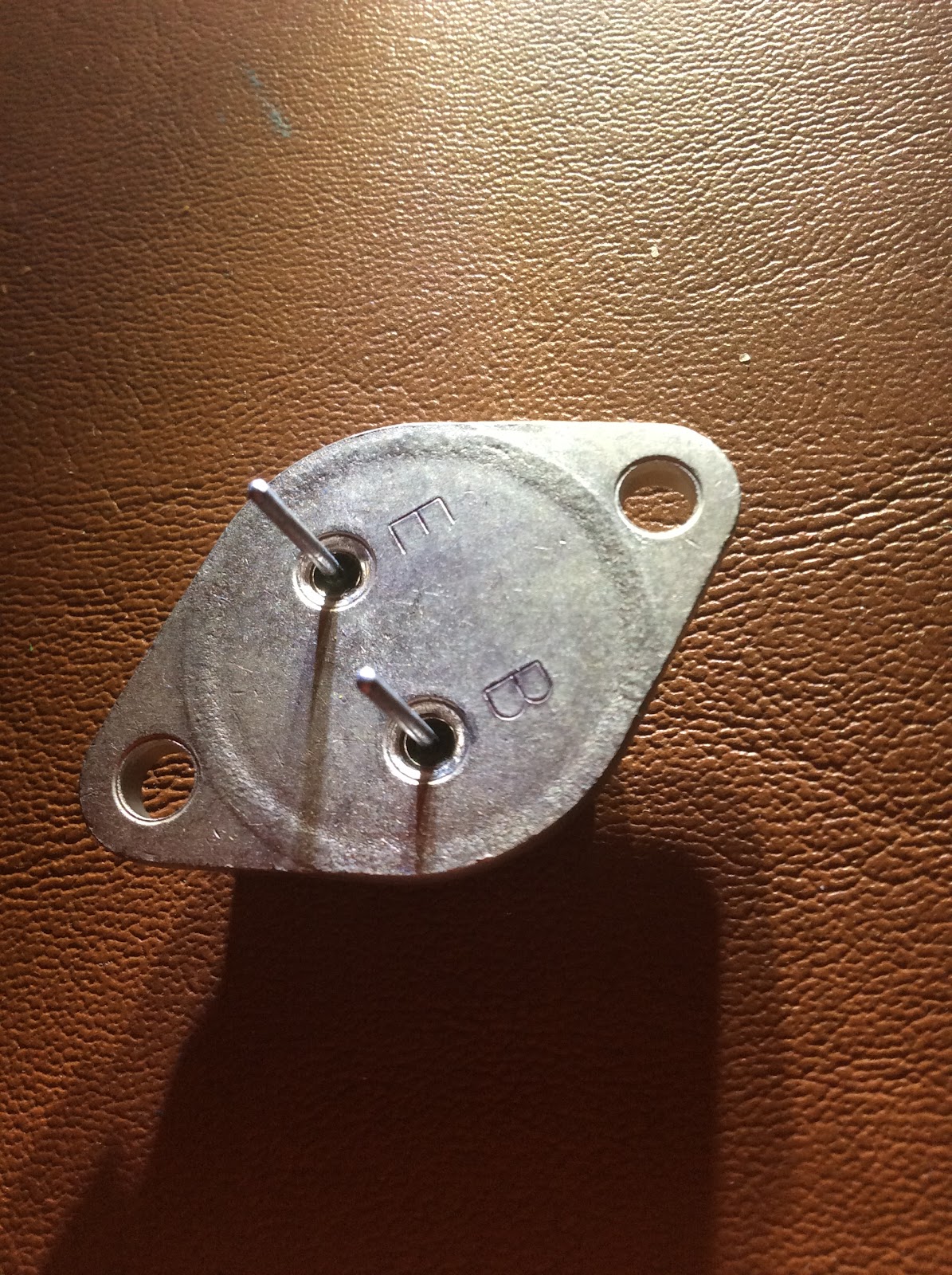
but the other side is suspicious:
Why are E and B engraved on a voltage regulator? E stands for emitter, B for base, which are the typical pins of a transistor. Then it became clear in my mind the LM317 is fake, actually a recycled transistor. Which explains why there was another one in the bag of components, why the pins were swapped and overall, why the project was never completed.

Temporary fix

For now, I replaced the LM317K by a LM317T in TO-220 package, mounted on the internal heatsink (which I guess was intended to a 7809 to power up the DVM) and everything works fine. I will chase for a real LM317K to complete this project, but I have a nice power working supply for my workbench. Great!

Comments

Popular posts from this blog

Drive replacement for Fostex DMT8-vl

The IDE hard drive on my Fostex DMT8-vl multitrack recorder shows signs of its imminent death; when getting hot, I could not record anymore. Must be said this drive comes from an old Sun Station, and has been replaced because I/O failures were detected by Solaris. It worked at least 5 years in my recorder: not so bad. However, time is now to replace it. The DMT8-vl is not able to handle drives bigger than 8.4 GB. Well, it is able to (the current drive is 15 GB), but only 8.4 GB will be usable. My tought was to use a 8 GB CompactFlash; having no moving parts means no noise, which is quite temptating for a music recording device. I purchased a CompactFlash-IDE adapter on the internet (8$) and I had to build a male-male IDE cable adapter (4$). Unfortunately, this doesn't work. The drive is correctly discovered by the operating system, which proposes to format it ("format IDE?"). After answering "yes", the formating runs pretty fast (faster than on a real drive), ...

Samba: Clients get "system error 1223" (or 123) after a server reboot

Facts: a Linux+Samba server shares anonymously a folder. After a reboot, Win clients could not attach the share drive anymore. C:\>net use \\mylinux\folder Enter the user name for 'mylinux': System error 1223 has occurred. The operation was canceled by the user. C:\>net view \\mylinux\ System error 123 has occurred. The filename, directory name, or volume label syntax is incorrect. The process are present, and tcpdump doesn't provide much information. What's going on? After hours of headscratching, the light came: the firewall was on and no rules for the Samba protocol! Grrr!

Issue with Soundpool MO4

I have a Atari STe with a Soundpool MO4 MIDI extension. It used to work very well, but unfortunatelly doesn't anymore: Cubase still detects it, and I can output MIDI to it but nothing is coming out from any MIDI Out. It took me a while to tackle it (lack of time, lack of tool, other items to play with), but I gave a glance last week-end. The parallel port on the Atari uses only the following signals: Pin 1 : Strobe (Atari -> MO4) Pin 2 : Data 0 (Atari -> MO4) Pin 3 : Data 1 (Atari -> MO4) Pin 4 : Data 2 (Atari -> MO4) Pin 5 : Data 3 (Atari -> MO4) Pin 6 : Data 4 (Atari -> MO4) Pin 7 : Data 5 (Atari -> MO4) Pin 8 : Data 6 (Atari -> MO4) Pin 9 : Data 7 (Atari -> MO4) Pin 11: Busy (MO4 -> Atari) The MO4 also decodes few other pins, but since the Atari doesn't, my guess is the MO4 was also targeted for PC. Inside the box, the MO4 is architectured around a CPLD (IspLSI1016 from Lattice) which contains the logi...